The Same Returns Can Produce Two Different Retirements
Why the order of gains and losses matters once you start spending from your portfolio.
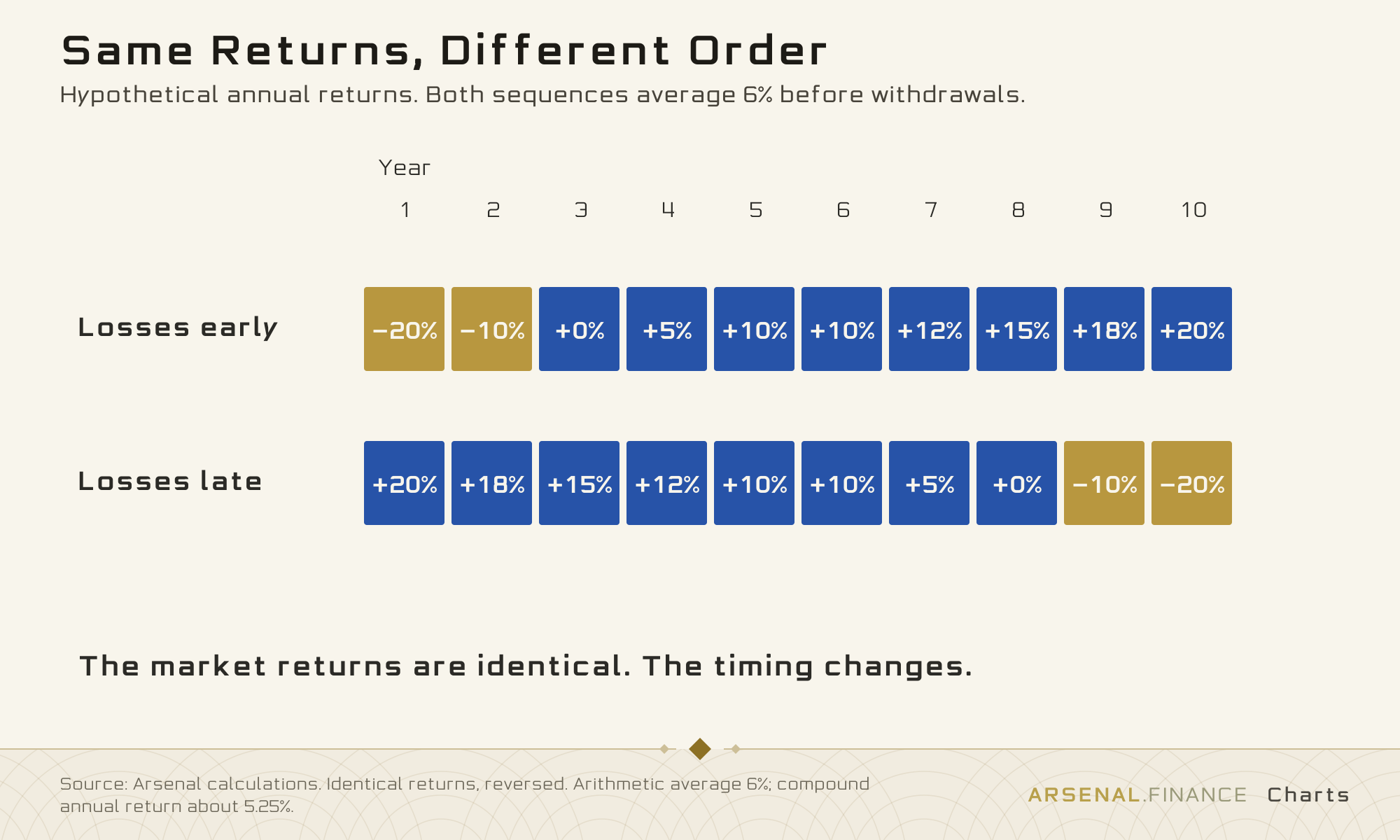
If two people earn the same investment returns, shouldn’t they end up with the same amount of money? That is true if they start with the same balance and leave it alone. Once they begin withdrawing money, the order of those returns can change the result substantially.
That’s a problem with building a retirement plan around a single average return. The spreadsheet may show a comfortable annual withdrawal, but it doesn’t tell you what happens if the first few years are bad.
Here’s a simple example. Two investors start with $500,000 and experience the same ten annual returns, in reverse order. One gets the losses early. The other gets them at the end.
Both sequences have a 6% arithmetic average and about a 5.25% compound annual return before withdrawals. With no money moving in or out, each $500,000 balance becomes $834,173. Multiplying the same returns in a different order doesn’t change the final product.
Now let each investor withdraw $25,000 at the start of every year. That’s $250,000 of total spending over ten years. The outcomes separate:
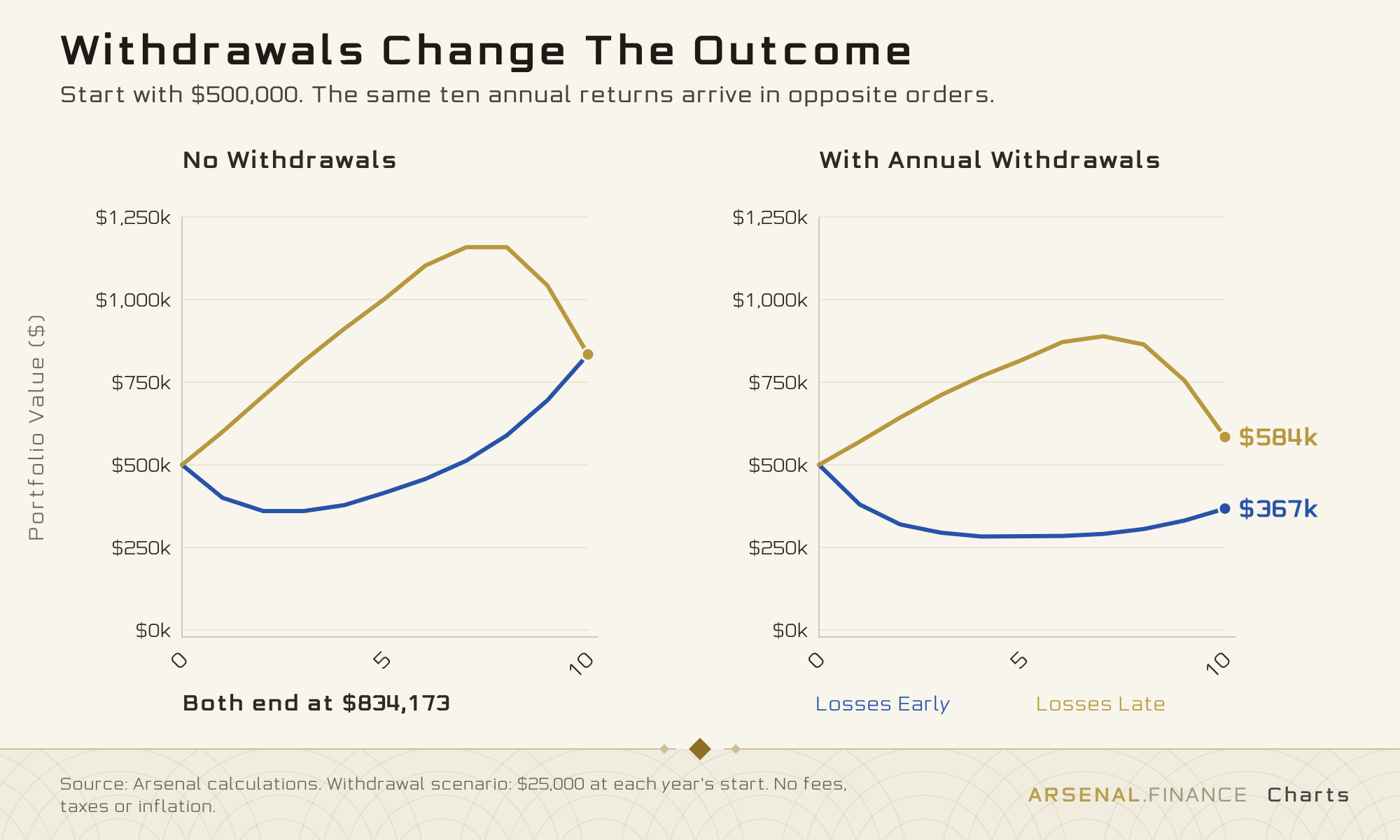
The investor who gets the losses first ends with $367,441. The one who gets them last finishes with $584,080. Same starting balance, same withdrawals, same set of market returns, but about $217,000 separates their remaining portfolios.
You can see the mechanism in the first year. After withdrawing $25,000, both have $475,000 invested. A 20% loss leaves the first investor with $380,000; a 20% gain leaves the second with $570,000. Next year’s identical withdrawal takes a much larger share of the smaller balance. Later gains then compound on less money.
This is sequence-of-returns risk. It becomes especially important when you depend on investments for spending, because a market recovery doesn’t replace the shares you already sold. It can also matter before retirement if you need a large withdrawal after a decline.
The example is deliberately simplified. These are invented returns, not a historical portfolio or a forecast. Spending stays fixed in dollars, so it loses purchasing power with inflation. Taxes and fees are excluded, and ten years is shorter than many retirements. A $25,000 withdrawal is an illustration, not a claim that 5% is a safe withdrawal rate.
What can you do with this? Start by testing an early decline instead of relying only on a smooth average. Separate spending that must happen from spending you could postpone. Cash or short-term high-quality bonds can cover some near-term expenses without selling stocks after a fall, although holding them has an opportunity cost and won’t remove every risk. More flexible withdrawals can help preserve capital, but that means accepting changes in your spending.
The useful question is how much room your plan gives you when returns arrive in an inconvenient order. Two portfolios can show the same long-run market return and support very different spending outcomes.
Start with our Net Worth Calculator to list what you own and owe. Then separate cash and investments you can draw on from assets such as your home, so your retirement plan reflects the money available for spending.
Sources
Schwab, Timing Matters: Understanding Sequence of Returns Risk: January 30, 2026. Mechanism of early losses with withdrawals. Our return series, withdrawal timing, calculations and charts are original hypotheticals.
Fidelity, Inflation and volatility in retirement: Retirement cash flows, sequence risk and inflation considerations. No recommended allocation adopted.
Vanguard, Show clients that yes, they can spend more in retirement: Flexible spending has tradeoffs; cited for framework only, not any simulation probability or withdrawal recommendation.
Arsenal Net Worth Calculator: Public page checked November 4, 2026. Lists assets and liabilities, calculates net worth and shows asset composition. The article does not claim it models sequence-of-returns risk.
Thanks for reading! Subscribe for free to receive new posts and support my work.
Disclaimer: The information above provided by Arsenal.Finance is for educational and informational purposes only and should not be construed as investment, financial, or legal advice. I am not a financial advisor. All investments involve risk, and the past performance of a security or financial product does not guarantee future results or returns. Always conduct your own research or consult with a professional before making any financial decisions.