How Inverse ETFs Work: Daily Resets and the Cost of Holding
Why a fund built to rise when stocks fall can lose money even when the market ends up where it started.
An inverse ETF sounds like the simplest hedge there is. If the S&P 500 falls 10%, the fund rises 10%, so you buy some when you’re worried and sell it when the worry passes. Right?
That is true for one day. ProShares says its Short S&P500 fund, ticker SH, seeks the opposite of the index's performance for a single day, before fees and expenses. The next day it starts again from wherever it finished, and that daily reset changes the result once you hold it for longer.
Here’s the arithmetic with $10,000 in a fund like this. The index falls 10% on the first day, so the fund gains 10% and is worth $11,000. On the second day the index recovers fully, which takes an 11.1% gain because it is climbing from a lower level. The fund loses 11.1% of $11,000 and ends at $9,778. The index is exactly where it started and you are down $222.
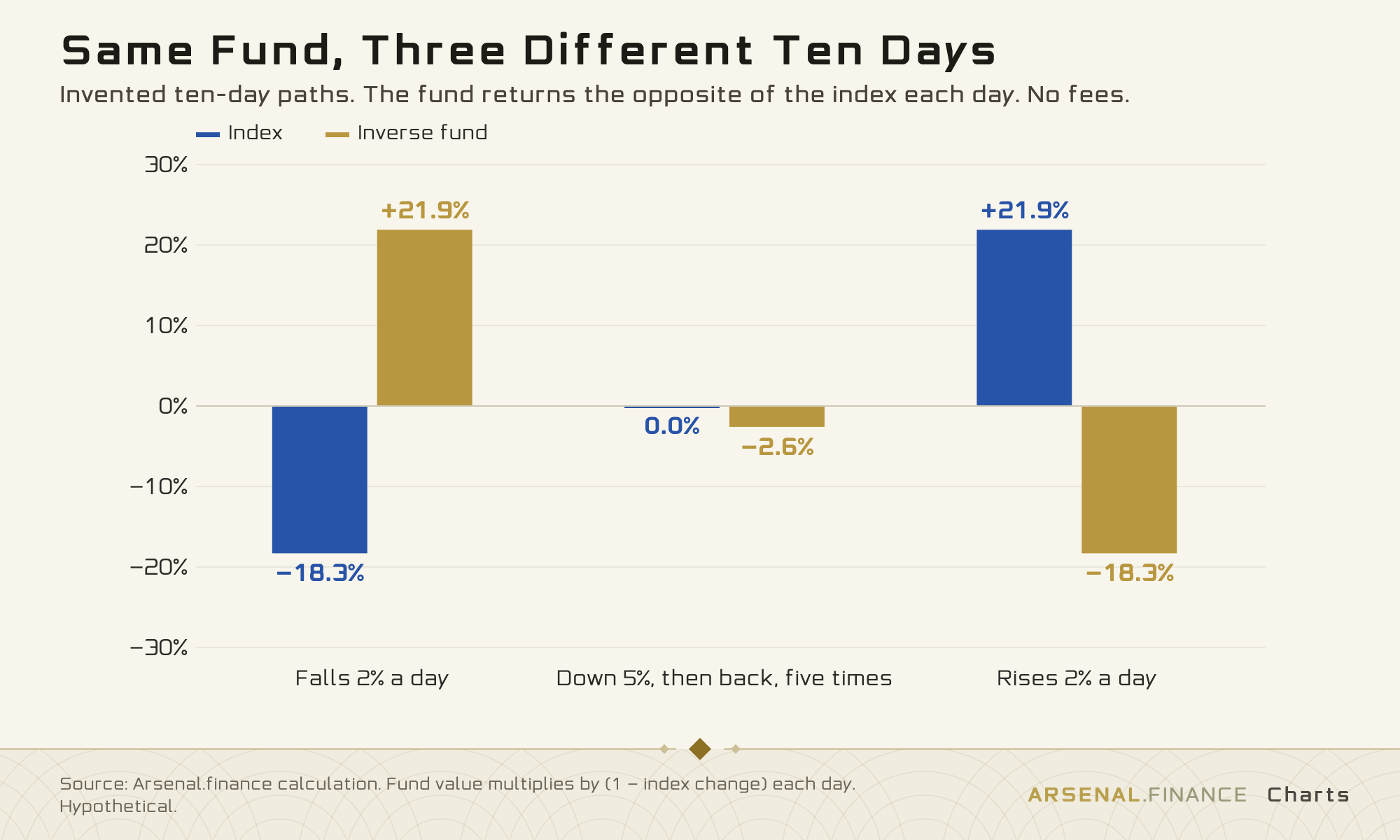
Nothing went wrong with the fund. It delivered the opposite of each day’s move, and the loss came from applying the second day’s percentage to a bigger balance. Now stretch that to ten days:
When the index moves steadily in one direction, the reset works in your favor. The fund gains 21.9% while the index loses 18.3%, and on the way up it loses less than the index gains, because each day’s move applies to a balance that has already grown or shrunk. When the index goes back and forth, each round trip takes a little out, so the fund loses 2.6% with the index unchanged.
So it’s wrong to say these funds always decay. What matters is the path, and the more the index swings without getting anywhere, the further the fund falls behind.
Does this show up in real life? Look at 2020.
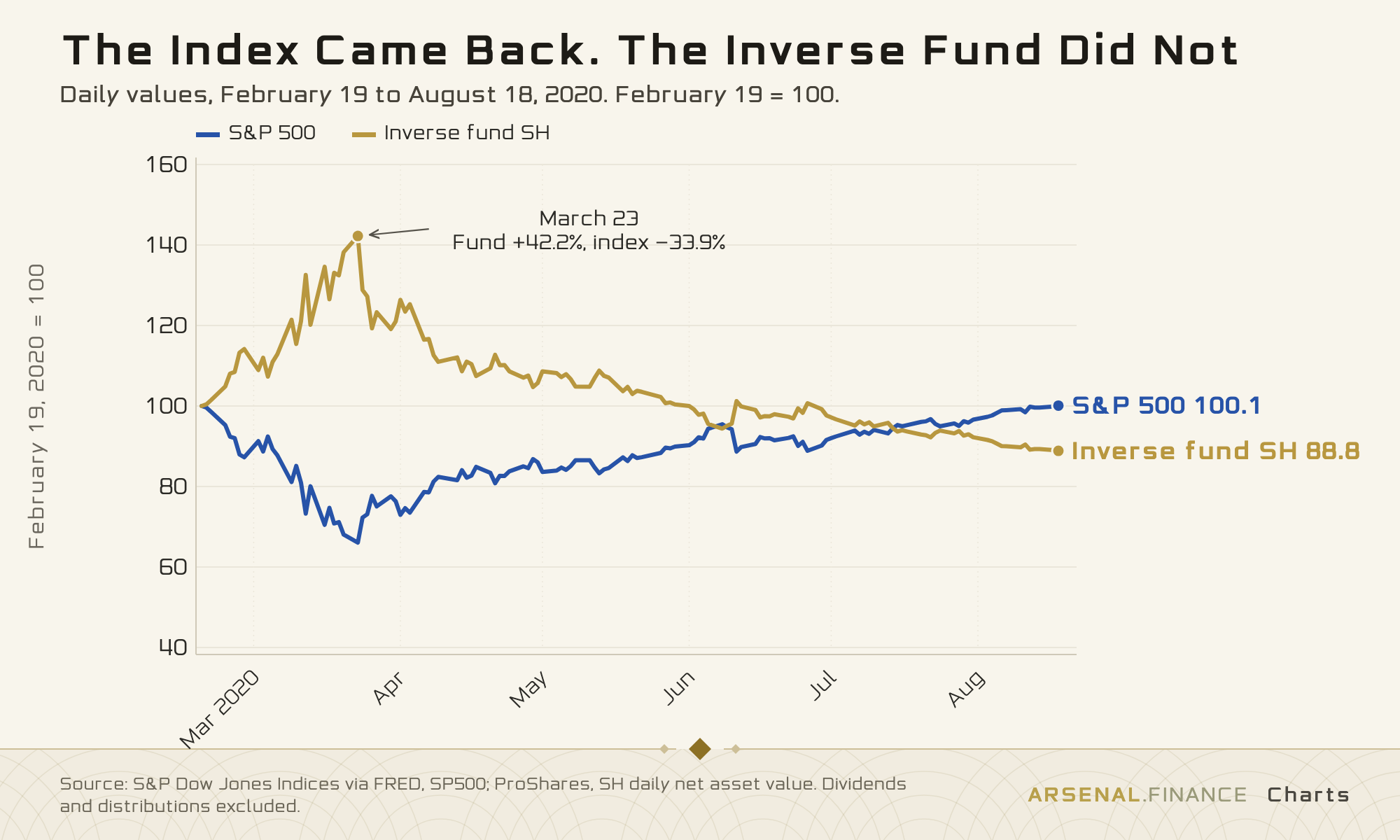
From the February 19 high to the March 23 low, the S&P 500 fell 33.9% and SH’s net asset value rose 42.2%. The market was heading mostly in one direction, like the first path in the chart above, so the daily reset worked in the fund’s favor and the hedge paid more than the index lost. But by August 18 the index was back above its February 19 close and the fund was 11.2% below where it started. Someone who bought the hedge at the peak and waited for things to calm down gave back the whole gain and more.
Was that the fund’s fees? Mostly not. Multiplying the opposite of each day’s index change over those six months, with no costs at all, already gives a 10.1% loss. The remaining difference reflects the fund’s expenses and the contracts it uses to get its exposure, and that is a separate cost of holding that you pay in every kind of market.
Even a year that went the right way shows the gap:
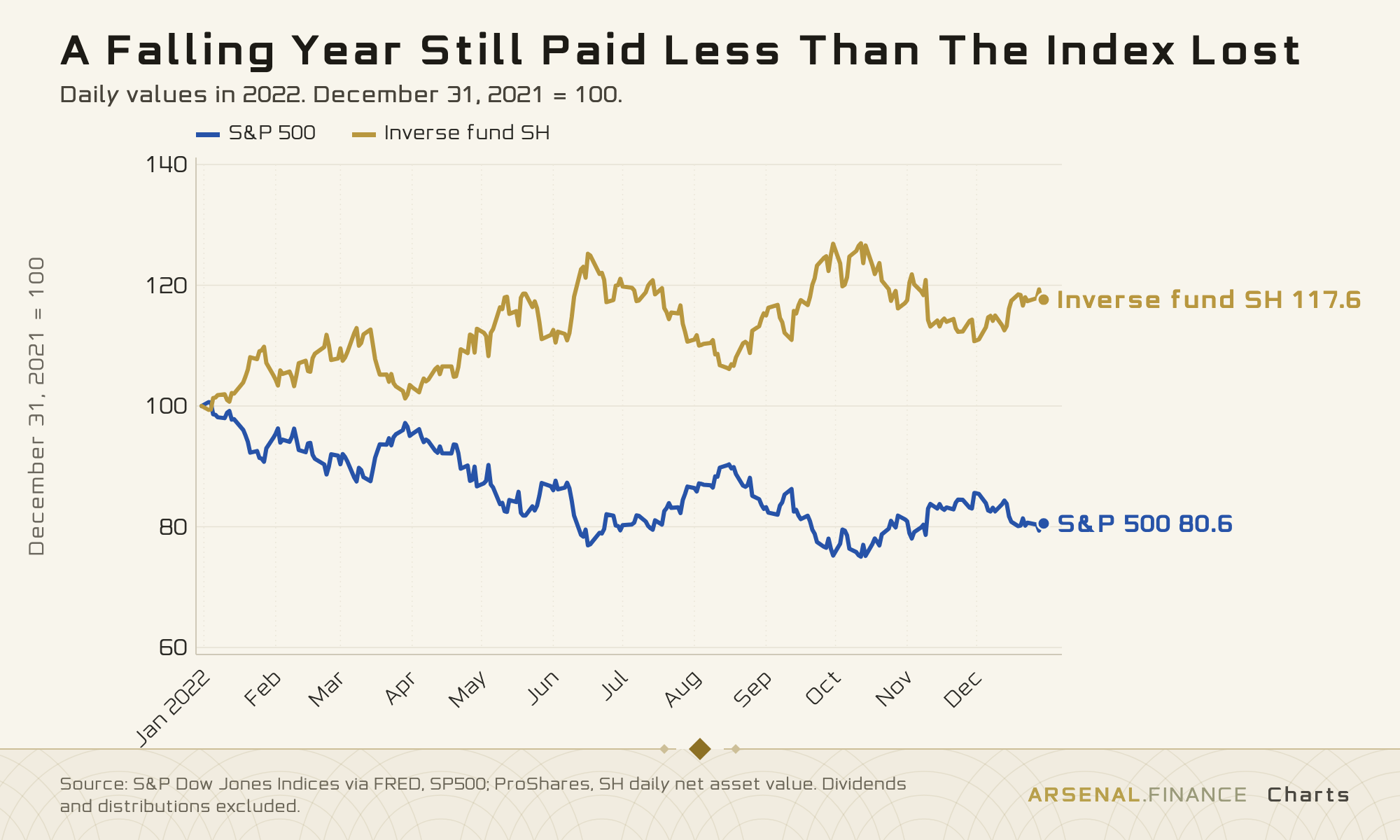
The S&P 500 lost 19.4% in 2022 before dividends, and SH’s net asset value rose 17.6%. It helped, but the decline came in waves with sharp rallies in between, so the fund did not return the mirror image of the year.
There is one more thing to watch if you use this as a hedge. Say you hold $10,000 of stocks and $10,000 of the fund. After a 10% fall you have $9,000 of stocks and $11,000 of the fund, so the hedge is now bigger than what it protects and a rebound costs you more than the stocks earn back. After a rally it is the other way around, and you have less protection than you planned. The fund resets itself every day, and you would have to adjust your own position to keep the hedge the size you intended.
That is why the SEC warns buy-and-hold investors that results over weeks or months can differ significantly from the daily objective. An inverse ETF is a tool for a specific risk over a short, defined period. Before using one, decide how long you expect to hold it and what you will do if the market swings sideways instead of falling, and compare the fund with the index over your own holding period instead of a single day.
You can test how a position like this would have changed a portfolio over different periods, with or without rebalancing, in the Arsenal portfolio backtester.